“I kept getting referrals from one customer who suggested I specialise. When I tracked where the profit actually came from, 73% came from similar work. I stopped resisting and changed the offering.”Morten, 41 — Copenhagen
How the method works
How to examine a business or income opportunity — and the decisions that follow.
The poster shows you what could happen. The method helps you examine what would have to be true.
Six disciplined questions move you from the claim you are shown to a present position you can explain before money, time or trust moves.
What exactly are you being asked to believe?
Not an instant verdict. A better examination.

Poster → Bridge → Pocket → Four Doors
One decision grammar, explained plainly.
Every opportunity — and many decisions that follow — has a version being presented, a real-world consequence, and a structure that has to connect the two.
The PosterThe promise you are shown, or the case being made for acting.
The BridgeThe evidence, assumptions, costs, conditions, incentives, risks and work carrying the decision.
The PocketWhat you will actually have to fund, do, carry or live with if you move.
The Four DoorsDifferent amounts and types of help around the same decision discipline. Not four compulsory steps.
The first decision may be whether to begin. If you do, the decisions do not stop. The same questions can be used when the next decision is about a supplier, partner, campaign, financing, pricing, expansion, persistence or exit.
Representative Decision Turns
Before the method gets technical, see what can change when someone looks again.
The examples below are not testimonials or proof of a promised outcome. They are composite illustrations of recurring decision patterns — kept here because a first-time reader should be able to recognise the kind of shift the method is designed to surface.
“The client said the price was too high. When I asked what they actually needed, their real problem was smaller than what I was selling. We built a narrower offering and they bought it.”Rosie, 33 — Sydney
“I had three possible services and changed my mind depending on who I spoke to. I asked for payment rather than opinions. The least exciting service was the only one people bought.”Zanele, 31 — Gqeberha
“My plan had roughly forty steps and not one required a customer to decide. I removed almost everything, asked ten people to pay for the simplest version, and three did.”Caleb, 28 — Austin
Evidence boundary: Names and identifying details are illustrative. The scenarios teach the decision pattern; they are not published as named-client evidence.
01What you are shownThe promise, number, claim or future being presented.
02What must be trueThe evidence, conditions, costs, work and missing information.
03What makes sense nowA present position you can explain before you commit.
Six questions change the picture
You do not have to become an expert. Start with six questions.
The questions are not six separate tests. They are one movement: from the claim in front of you toward a clearer present position.
01Claim
What exactly is the claim?
Strip away the excitement, presentation and sales language. What result is actually being offered, to whom, and under what circumstances?
02Support
What supports the claim?
What can you actually see — documents, numbers, contracts, customer evidence, operating history or independent information?
A confident answer is not the same as a qualified answer.
03Gaps
What is still missing?
How many people did not get the advertised result? What does an ordinary result look like? What costs appear later? What happens if you want to leave?
Something worth finding out
A missing answer does not automatically mean something is wrong. It means you still have something worth finding out.
04Cost
What will it really cost you?
The price on the page may be only one part of the commitment. The real cost is the commitment required to reach the result.
05Conditions
What has to go right?
Customers may have to arrive. Sales may have to happen. A supplier or platform may need to perform. You may need to recruit, learn, advertise, drive, manage, sell, service or follow up.
Under your controlYour preparation, work, follow-up and decisions.
Outside your controlCustomers, platforms, suppliers, markets and other people.
And if it does go right?
Success can create its own costs, workload and dependencies. If the opportunity works as hoped, what happens next?
06Position
What makes sense now?
Once the picture is clearer, the question changes from “Do I like this?” to:
Knowing what I know now, what is the most sensible next move?
Your present position — not a manufactured certainty.
Keep four things apart
A claim does not become a fact because it sounds believable.
EstablishedInformation that has something meaningful behind it.
ClaimedSomething somebody says is true but that still needs support.
AssumedSomething you may need to accept temporarily while examining the opportunity.
UnknownInformation that remains missing or unresolved.
The method does not punish uncertainty. It makes uncertainty visible.
Claim to Cash
Follow the number all the way to your pocket.
The number on the poster is not always the number that matters.
Whose result?One exceptional person? An average? A median? Only people who were already successful? Everyone who joined?
Which clock?Paid time? Working time? Waiting time? Travel time? The hours required to create the result?
Which costs?Fees, fuel, advertising, finance, equipment, inventory, returns, software, taxes — or anything else required to keep the opportunity operating.
Which conditions?Eligibility, targets, minimum activity, payment thresholds, customer requirements, renewals or approval rules.
Claim to Cash is not designed to make the number look worse. It is designed to make the number more useful for a decision.

Fit matters
An opportunity can be real — and still be wrong for you.
Sometimes the better question is not “Is this legitimate?” It is “Does this make sense for me?”
A genuine business can still require more money than you can safely risk. A genuine franchise can still be wrong for your location. A real course can still require skills or advertising money you do not have. A legitimate gig opportunity can still produce poor economics once vehicle costs and unpaid time are included.
Legitimate does not automatically mean suitable.
That is why the method also examines your available money, your time, your skills, your obligations, your ability to absorb a loss, how easily you can reverse the decision, and what happens if the expected result takes longer than promised.
The opportunity matters. So do you.
Give the optimistic case its best chance
Assume it works. What happens next?
Success is not a reason to reject an opportunity. It is another condition worth understanding.
If this works, what will you actually have to do, fund, manage or live with next?
This is not a seventh framework question. It deepens Question 5: What has to go right?
Different posters. The same discipline.
The questions change slightly. The method does not.
Direct selling or MLMWho actually earns? How much depends on real customers? What are the ongoing costs? How much depends on building a team?
Franchise or licenceWhat is the full opening cost? How many signed locations actually open? What working capital is required? What happens to locations that close?
Course or coachingWhat is included? What additional tools, advertising or services will you need? Are the results showing sales or actual profit?
Managed ecommerceWhat do you pay upfront? Who controls the store? How much working capital and advertising are required? Who carries the loss?
Gig or platform workWhich hours count? What does the vehicle really cost? How much time is unpaid? What remains after fuel, finance, insurance and other expenses?
Affiliate or referralWhen does a referral become payable? Can commission be reversed? Is there a minimum payout? How long until the money can be withdrawn?
AI reseller or automationDoes the technology work? That is one question. Can you find and retain paying customers profitably? That is another.
The category changes. The discipline remains the same: examine what sits between the poster and your pocket.
Three possible paths
A careful decision does not always end with yes or no.
Proceed
The opportunity appears sufficiently understood, the downside is tolerable, and you know what you are committing to.
Proceed only if…
A document arrives. A claim is verified. A price changes. A trial succeeds. A contract is amended. A particular risk is limited.
Do not proceed — or not yet
Sometimes “I need more information before I move” is the most intelligent decision available.
The point is not to force certainty. The point is to make the next move explainable.
Why “before” matters
Before you commit, you usually have more choices than you will afterward. You can ask another question, request a document, run a smaller test, negotiate a condition, wait or walk away. A careful decision does not manufacture certainty. It helps you keep useful choices open long enough to decide.
AI, structure and lived judgement
AI can process information. Lived experience helps us notice which questions deserve another look.
We use AI and the Premise Decision Engine to organise and examine information. We do not pretend that processing information and living through commercial consequence are the same thing.
More than 35 years of business and decision experience
The work draws on more than 35 years of real-world business and decision experience. That experience does not make anyone infallible. It adds a human judgement layer to the questions being examined.
Structured use and feedback involving 425 leaders and their teams
The reasoning method was refined through more than two years of structured use and feedback involving 425 leaders and their teams. That history belongs to the method; it is not a claim that 425 people bought any current Careful Optimist product.
Neither AI nor experience makes the final decision for you. The purpose is to return a more qualified present position to the person who must live with the outcome.
What the method will not do
We do not replace one confident sales pitch with another confident opinion.
- We will not call something a scam simply because it looks unusual.
- We will not call something safe simply because the company exists.
- We will not treat a registration, licence, testimonial, contract or successful person as proof of everything else being claimed.
- We will not manufacture certainty where the information does not support it.
- We will not decide how much risk you should be willing to live with.
We help you examine. You remain the decision-maker.
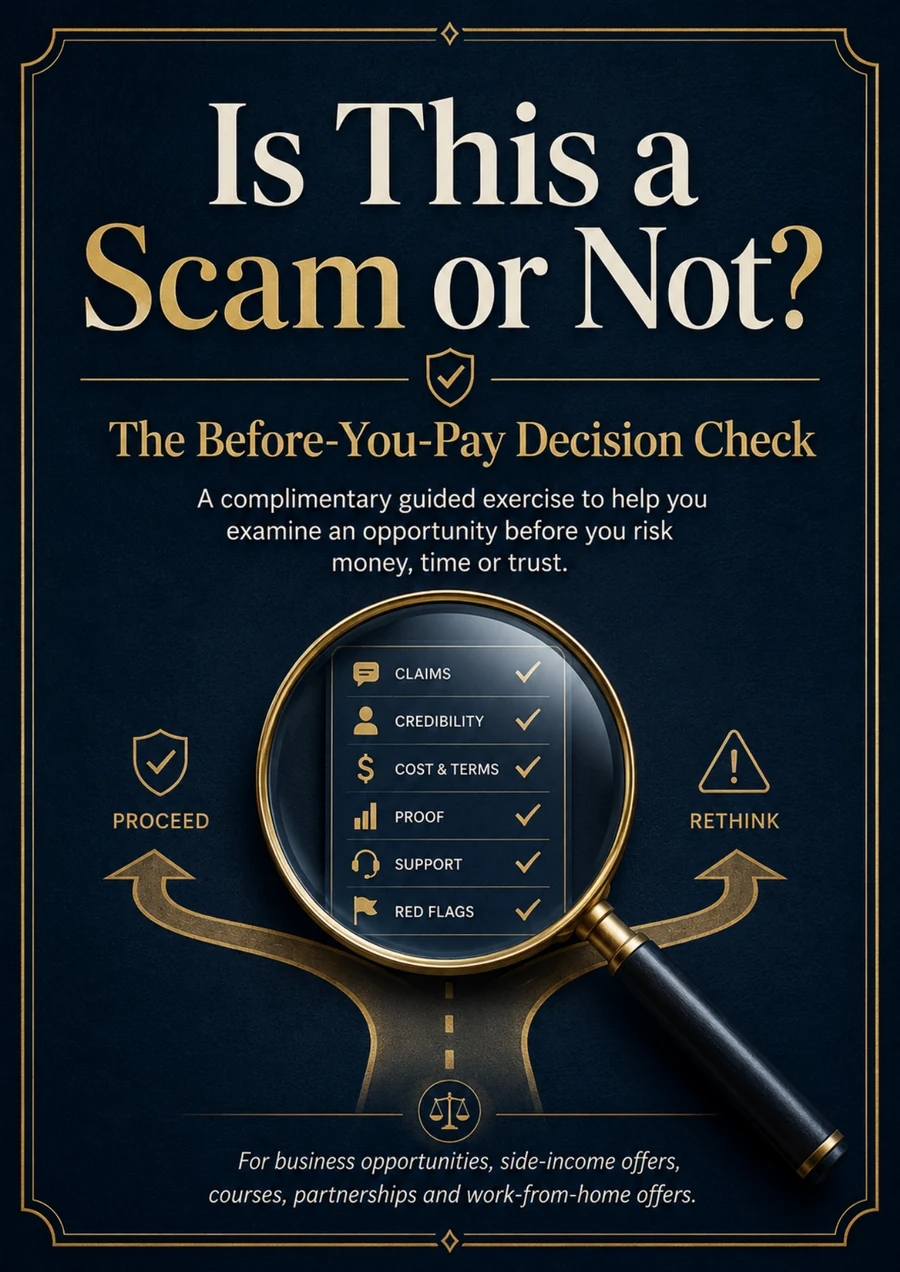
Start with the opportunity in front of you
Give it one careful examination before money, time or trust moves.
The Complimentary Digital Decision Check gives you a practical place to begin.
One real opportunity. One careful examination.
Bring the opportunity in front of you. Separate what is being claimed from what you can establish, identify what is still missing, make the cost and requirements visible, and test whether it fits your life before money, time or trust moves. It may be all the help you need.
Still hopeful. No longer naïve.
No instant verdict. No pressure. The decision remains yours.
Want to see the method tested first?See Proof Under Pressure →